Overview
Why This Benchmark
Many scientific benchmarks primarily test whether a system can produce a correct answer or complete a task under extensive human guidance. ASI-Bench targets a different setting: long-horizon, project-level research in which the system must turn scientific decisions into verifiable results.
The benchmark is designed to test whether an agent can:
- understand a scientific objective
- inspect provided data and decide what matters
- choose an appropriate method
- implement and debug the workflow
- produce output artifacts that can be checked objectively
This measures sustained end-to-end investigation rather than a single-prompt exam or the execution of a fixed procedure.
Current Benchmark at a Glance
- 60 project-level research tasks in the first release, spanning 11 scientific domains
- more than 1,300 candidate research ideas, 1,100 review assignments, and 2,000 task revisions during construction
- more than 31,000 human-hours and 1,500 sandbox runs invested in review and validation
- more than 2,600 interaction turns, 2,400 execution steps, and 35 hours of agent execution across the retained tasks
All retained tasks undergo expert review, AI-assisted auditing, sandbox execution, and scorer validation. The benchmark is community-driven and is intended to grow beyond the first release.
What Project-Level Means
In this benchmark, a task is not only a prompt. A task includes metadata, runtime requirements, data or instance generation, expected artifacts, scoring rules, and public-safe summaries for website rendering.
A successful agent run should leave behind evidence:
- generated data files or figures
- implementation code
- structured answer artifacts
- scoreable outputs
- run metadata and provenance
That evidence is important because the website is intended to support official leaderboard results, not just informal model comparisons.
How It Differs From Related Benchmarks
| Benchmark family | Typical focus | ASI-Bench difference |
|---|---|---|
| QA-style science benchmarks | answer correctness | evaluates multi-step scientific workflows and artifacts |
| coding benchmarks | code generation or issue repair | adds scientific method selection and domain interpretation |
| ScienceAgentBench / AstaBench | broad science-agent evaluation | emphasizes project-level tasks with B1-B4 prompt-level control |
| SkillsBench-style agent benchmarks | agent/tool skill use | uses scientific tasks and reproducible scoring as the primary surface |
The benchmark therefore evaluates a model–harness system as a research system, not the backbone model in isolation.
B1-B4 Prompt Levels
ASI-Bench evaluates the same scientific objective under four prompt levels:
- B1: scientific background, method, equations, and procedural guidance are provided.
- B2: the intended methodological approach and relevant constraints are provided, while implementation decisions remain with the agent.
- B3: only the objective, available inputs, constraints, and required outputs are provided; the agent selects the strategy and method.
- B4: the complete B3 task is retained and factually correct but non-essential information is added to test robustness to distraction.
The goal is to measure how much scaffolding an agent needs before it can solve a scientific workflow reliably.
B1-B4 Prompt Ladder
Same task goal, same data, same evaluation; guidance decreases as autonomy increases.
Full procedure
Background, method, equations, and procedural guidance are supplied.
Method specified
The methodological approach and constraints remain; implementation decisions do not.
Method autonomous
The objective, inputs, constraints, and outputs remain; the agent determines how to solve the task.
Distractor robustness
B3 remains complete while correct but non-essential context is added.
Only methodological information changes: the objective, data, required outputs, and evaluation criteria remain fixed.
What the Current Evaluation Shows
Across 21 Agent×Model configurations, the all-system mean falls from 51.72 at B1 to 29.72 at B2, 27.48 at B3, and 27.63 at B4. The largest drop is B1→B2 (−22.01), while removing the method itself from B2→B3 causes a further 2.24-point decline and B4 changes little from B3.
The main observed bottleneck is therefore method operationalization: current systems struggle more to turn a specified scientific method into a complete, validated research procedure than to select the method or ignore non-essential context.
Task Lifecycle
The public website is generated from structured benchmark metadata. In the long term, each task page should expose:
- task title and identifier
- domain and subdomain
- public summary
- expected output types
- high-level evaluation summary
- runtime and sandbox notes
- safe prompt excerpt
The current public catalog is intentionally scoped to tasks that are ready to be shown on the benchmark site.
Evaluation Workflow
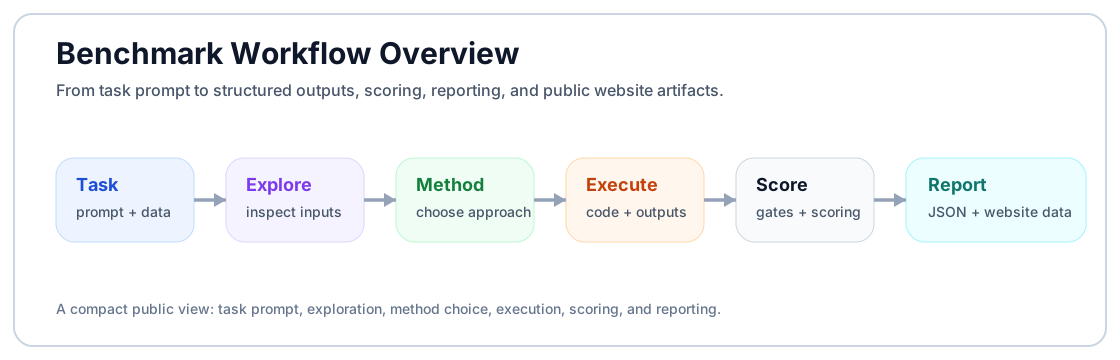
At a high level, the evaluation loop is:
- Read the task prompt and inspect the provided data.
- Decide on an appropriate scientific or computational method.
- Implement the solution and generate required artifacts.
- Produce structured outputs such as data files, figures, and code.
- Submit the produced artifacts for official evaluation.
- A maintainer scores the confirmed run against the private reference material and records the result for reporting.
External runners use asibench run --no-score and cannot compute an official score locally. Reference answers and task-specific scoring configuration remain private; self-reported scores are not used for the official leaderboard.
Examples of result artifacts include:
run_metadata.jsonfor run-level provenance- per-instance result JSON files
batch_overview.jsontask_scoreboard.jsontask_level_long.json
Reproducibility and Contamination Control
The benchmark design emphasizes:
- sandboxed execution modes
- explicit runtime requirements
- structured output contracts
- parameterized ground-truth generation
- provenance attached to saved results
Parameterized generation helps reduce contamination risk and makes it easier to produce multiple scoreable instances without hand-authoring every case.
Leaderboard Readiness
The official leaderboard should eventually show reviewed runs accepted by benchmark maintainers. Each official result should include:
- agent or harness name
- model name
- overall score
- B1-B4 breakdown
- task coverage
- benchmark version
- evaluation date
- source or trace links when available
- trust label such as
official,reproduced,community, orunverified
This separation matters because official baselines and community submissions should not be mixed without clear provenance.
Community
Join the ASI-Bench community to discuss evaluation results, get help running the benchmark, and connect with task contributors.

Join the ASI-Bench Discord
Ask evaluation questions, discuss published results, and follow benchmark updates with the wider community.
Join Discord
Join the ASI-Bench WeChat group
Scan the group QR code for Chinese-language updates and contributor discussion.
Show WeChat QR code
 Open WeChat and scan this code to join. If the code has expired, ask for an updated invite in Discord.